

“For those who come after.” – Tagline for Clair Obscur: Expedition 33
Across the vast ocean, you gaze upon the image that has haunted you all your life: a giant woman resting beneath the number 34. Flowers bloom all around, deceptively masking the truth—that your city is slowly crumbling. She is the Paintress, and each year she paints the next descending number. Those whose age matches it will die. This year, it’s your girlfriend’s turn, and you descend to meet her before she is erased. Next year, it will be yours.
Clair Obscur: Expedition 33 was released earlier this year to astonishing critical acclaim. The debut game by studio Sandfall Interactive was an attempt to create their own turn-based role-playing game. They were inspired and influenced by their love of Japanese role-playing games, such as the Final Fantasy and Persona series, but with their own twist. It has been lauded not only by long-time fans of the genre, but by titans in the video game industry, such as Hideo Kojima and Ken Levine.

The intro alone, as I described before, was enough to hook me. With the somber, bewitching melody of “Lumière”, players are drawn into a Parisian-inspired city on its last legs. Despite its beauty, unease lingers in the air—buildings crumble into disrepair, and black ink-like blots stain the corners. As the inhabitants gather for the annual Gommage, a sense of dread and resignation settles over the city. Then the event begins, and you learn why.
Each year, the Paintress paints a new number, and everyone of that age vanishes. With every Gommage, Lumière grows closer to erasure. Yet not all accept this fate. The Expedition—a group sworn to confront the Paintress across the ocean—seeks to end the deadly cycle once and for all. You play as Gustave, the newly chosen captain of Expedition 33. Alongside him are his foster sister Maelle, his scholar friend Lune, and Sciel, a fighter who wields enchanted cards. Together, they uncover secrets of past Expeditions, meet living paintbrush-like allies called Gestrals, and battle the strange, ink-born Nevrons. Later, three new companions join your journey: Verso, the enigmatic survivor of a past Expedition; his best friend Monoco, a Gestral with a dry wit who shapeshifts in battle; and Esquie, a childlike guide who helps you traverse the map faster than you ever could on foot.
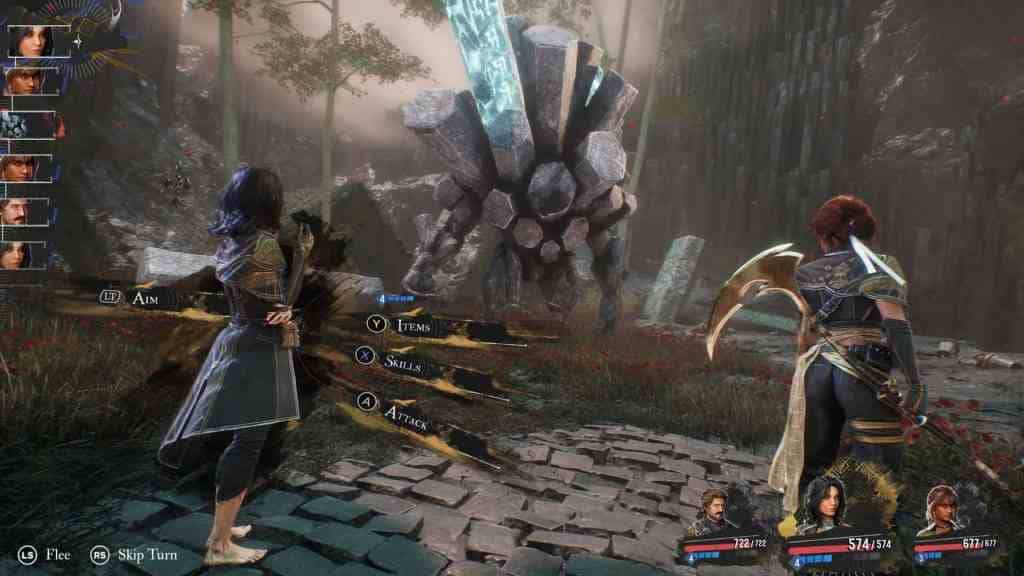
As in traditional turn-based RPGs, your strength lies in building the right team and exploiting elemental affinities. Weapons and spells are tied to elements—Physical, Fire, Ice, Earth, Lightning, Dark, Void, and Light—and striking an enemy’s weakness can turn the tide of battle. What truly sets Clair Obscur apart, however, is its dodging mechanic. Unlike many RPGs, dodging isn’t a guaranteed escape with a button press. You must study each enemy’s movements, anticipate their attacks, and time your dodge or jump with precision. It demands memorization, focus, and sometimes sheer luck—making every encounter tense and far less forgiving than it first appears.
While I do believe Clair Obscur deserves its accolades for creating a rich and imaginative world that I want to discuss more of, I don’t think it’s a perfect game. There are some elements missing that I think would have made for a smoother and less frustrating experience that I hope Sandfall will take into account in future titles.
First, unlike most Japanese RPGs I’ve played, there is no flee button. If an enemy catches you, you have to play through the battle. And if you lose, well…get ready to start again where the game last auto-saved. An escape option from battle would prevent that, especially if your team is not nearly as prepared.
There are also some side-quests and activities that you can partake in, but it can be hard to find where they are, especially later on when so much plot is thrown at you. A quest list would have been a nice addition to help me know what else there was for me to go back to and try to finish before continuing with the main story. Maybe a journal to record new plot developments and lore drops, aside from the Expedition journals you come across throughout the game.

The role-playing systems in Clair Obscur felt a bit convoluted at times, and I often wished the game explained certain mechanics more clearly. Throughout your journey, you’ll collect abilities called Pictos, which can enhance—or occasionally hinder—your battle strategy. To unlock their potential, you’ll need Lumina, colored orbs scattered across the world, and Chroma, a resource that not only powers up abilities but also serves as the game’s currency.
Without a proper map for each section, exploration can become disorienting, adding unnecessary frustration. Battles, too, sometimes drag on: enemies often take multiple turns while you’re limited to one or two, stretching fights far longer than they need to be. In one case, a single encounter lasted nearly forty minutes!
Clair Obscur is definitely a love letter to classic JRPGs, and that love is evident in its brilliant use of music and world-building. It was so refreshing to see characters travel across a world map just as you would have in classic Final Fantasy titles. The visuals and music for the game are hauntingly beautiful, and considering that this is the first title of a very small studio of only 33 core people, it is no mean feat.

The theme of the game also takes a page from classic role-playing games such as Final Fantasy X in that it is ultimately a story about death and grief. While Gustave and his team are off to face the Paintress in order to destroy the cycle of death, you come to find that death is in the very makeup of the world. Each party member has their own unique relationship and views on death – Lune is determined to press on regardless of the cost, setting aside her emotions and relying on cold logic to press ahead, even as her loved ones around her are threatened. Sciel has the most ambivalent attitude towards death; she sees it as a sad inevitability in their world, but does not fear it, instead thinking that “Death is a friend who will welcome me home.” As the youngest Expeditioner, Maelle has the most emotional relationship with loss, and the more of it she faces, the more it gradually wears her down throughout the course of the game.
Despite its dark and somber subject matter, Expedition 33 is beautifully crafted in every respect. From its story and themes to its art and music, each element offers something that can genuinely take your breath away. It is also a game that invites reflection; the world of Lumière and the people within it prove far more complex than they first appear. I think there’s a reason why Expedition 33 has won so many accolades and why Sandfall should give themselves a pat on the back; it gives itself permission to create a world that ensues creativity in every sense of the word, and use that creativity to delve into deeper truths about the human condition.
When you pick up a copy of Expedition 33, it invites you to ask a difficult question: how would you spend the remainder of your life if you knew you had only a year left? Would you make peace with it, fight the inevitable, or try to build a legacy that outlasts you? For Christians, that question carries a different weight. We believe death is not the end, and that Christ promises resurrection in a renewed Heaven and Earth beyond anything we could imagine. Yet that hope does not erase the reality of grief; the pain of loss still lingers when we say goodbye to loved ones or confront our own mortality. I’m so grateful for Clair Obscur: Expedition 33 for allowing me and so many other players to go on that journey, and to reflect more deeply on both the fragility of life and the hope that lies beyond it.